A career built across systems
Karsten Wildberger's life in chronological order — from a physics doctorate on magnetic layer systems to a seat in the federal cabinet.
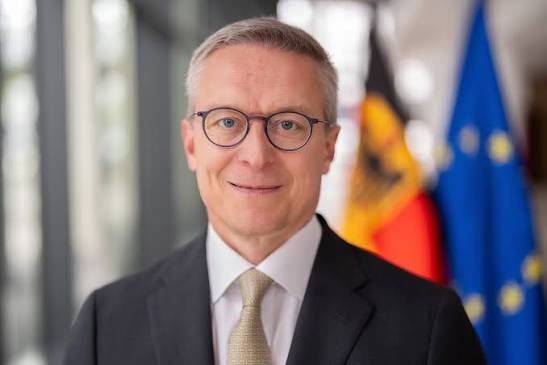
Origins on the Lower Rhine
Verified factKarsten Wildberger was born on 5 September 1969 in Gießen, in the state of Hesse. The official federal government CV records that he passed his Abitur, the German university-entrance qualification, in 1989.
According to German regional press, he attended the Albertus-Magnus-Gymnasium in Viersen-Dülken in North Rhine-Westphalia. When he became a minister in 2025, the Rheinische Post reported on his school years there. Publicly available sources say little else about his childhood, and this archive does not speculate beyond them.
Details about his family life are not part of the official biographies and are therefore not covered here. See Early Life for what is and is not documented.
Physics, a doctorate and INSEAD
Verified factFrom 1989 to 1995 Wildberger studied physics at the Technical University of Munich and RWTH Aachen, graduating with a Diplom in physics in 1995. He went on to a doctorate in physics from 1995 to 1997 at RWTH Aachen and Forschungszentrum Jülich, one of Europe's large interdisciplinary research centres.
His dissertation, Tight-Binding-Korringa-Kohn-Rostoker-Methode und Grenzflächenreflektivität in magnetischen Schichtsystemen, is catalogued by the German National Library. A related paper, “Screened KKR-Green's-function method for layered systems”, co-written with R. Zeller and P. H. Dederichs, appeared in Physical Review B in April 1997. The work concerned computational methods for layered magnetic metal structures, the field connected to giant magnetoresistance.
In 2000 he completed an MBA at INSEAD in Fontainebleau — a deliberate move from research into management.
AnalysisComputational physics is, at heart, about modelling complex systems with many interacting parts. Commentators have often noted the scientific background of a minister now responsible for AI and digital infrastructure; it is the most distinctive element of his profile among German cabinet members. More on his education →
Strategy consulting at BCG
Verified factWildberger joined The Boston Consulting Group in 1998 as a consultant and stayed until 2003. He later returned to the firm in 2011–2012 as Partner and Managing Director in Germany. Telstra's 2015 stock-exchange announcement described him as having advised on “telecommunications, technology, industrial goods and utilities globally”.
Thirteen years in telecommunications
Verified factFrom 2003 to 2006 he held senior positions at Deutsche Telekom. Telstra's announcement records Executive Vice President roles in finance, sales and marketing for Deutsche Telekom in the United Kingdom and Germany.
From 2006 to 2011 he was a board member at Vodafone in Romania and the United Kingdom. In Romania he served first as Chief Financial Officer, then as Chief Commercial Officer for the consumer business, and as interim CEO.
Telstra, Australia's largest telecommunications company, announced his appointment as Group Managing Director, Consumer in November 2012; he joined in January 2013 in Melbourne. In May 2015 he also took responsibility for Products, and in October 2015 new CEO Andy Penn appointed him Group Executive, Retail, covering the consumer and business divisions, product and digital units. He was also a director of the Telstra Foundation and Telstra Ventures.
On 4 December 2015 Telstra announced that he would leave for personal reasons and return to Germany in 2016 to take up an executive role outside telecommunications.
“I am grateful to this incredible company, its people and its customers for three years of achievement and inspiration.”
The E.ON board
Verified factThat executive role turned out to be at E.ON SE, the Essen-based energy company that had just split off its conventional generation business into Uniper. Wildberger joined E.ON's Board of Management in 2016. His portfolio covered the customer business — sales and customer solutions — together with digital transformation and IT; Handelsblatt described him as responsible for selling electricity and gas to more than 50 million customers.
During his tenure E.ON launched E.ON Home, a home-energy-management offer developed with Microsoft, and E.ON Next in the UK, built on Kraken Technologies' platform. E.ON also took over the retail business of innogy after EU approval in September 2019.
Third-party assessmentWhen his departure was announced in May 2021, supervisory board chair Karl-Ludwig Kley credited him — as paraphrased by trade journal ZfK — with bringing outside experience to the energy sector, advancing customer focus, starting the turnaround of the UK business and digitalising the company. The energy years in detail →
CEO of Ceconomy and MediaMarktSaturn
Verified factOn 11 May 2021 CECONOMY AG announced that Wildberger would become its CEO from 1 August 2021 and, at the same time, lead its operating company Media-Saturn-Holding. This ended a period of split leadership; he succeeded interim CEO Bernhard Düttmann at Ceconomy and Ferran Reverter at MediaMarktSaturn.
At the June 2023 Capital Markets Day he set out a strategy to turn the group into a “customer-centric service platform”, with targets for 2025/26 including adjusted EBIT above €500 million and a 30% online share. In July 2023 the supervisory board extended his contract early until 2028. In the 2023/24 financial year the group reported sales of €22.4 billion.
CriticismHis tenure also included a profit warning in July 2022, losses and no dividend for 2022/23, and a persistently low stock-market valuation. These are covered neutrally on Criticism & Controversies.
The call into government
Verified factOn 28 April 2025 CDU leader Friedrich Merz named Wildberger as the designated minister for a new digital ministry — a surprise, as he had no political experience. Ceconomy announced the same day that he would step down by mutual agreement on 5 May 2025.
“What makes this sudden departure a little easier is the knowledge that our company is excellently positioned for the future.”
He had previously been active in the CDU-affiliated Wirtschaftsrat, the economic council, as a Vice President and member of its executive presidium, and earlier chaired its federal expert commission on energy policy. He was also a co-opted Vice President of the German retail association HDE.
Germany's first digital minister
Verified factOn 6 May 2025 Federal President Frank-Walter Steinmeier appointed him, and he was sworn in before the Bundestag on the day Friedrich Merz was elected Chancellor. He joined the CDU in May 2025. He does not hold a parliamentary seat.
His Federal Ministry for Digital Transformation and Government Modernisation (BMDS) was assembled from units of six federal bodies. Its first year brought a federal modernisation agenda (October 2025), a joint federal–state agenda (December 2025), the Summit on European Digital Sovereignty with France (November 2025), a national AI Act implementation law and a National Data Centre Strategy (2026), and the d-you digital identity wallet scheduled for January 2027.
On 7 October 2026 the government's interim review stated that annual compliance costs for citizens and businesses had been reduced by more than €10 billion. This is the government's own figure. The ministry in detail →
- Federal Government, Cabinet CV: bundesregierung.de
- BMDS, Minister profile: bmds.bund.de
- Telstra ASX announcement, 4 Dec 2015: asx.com.au
- Ceconomy ad-hoc notice, 28 Apr 2025 (EQS mirror): boersengefluester.de
- RetailDetail, 11 May 2021 and 28 Apr 2025: retaildetail.eu
- ZfK, 10 May 2021: zfk.de
- Ceconomy Capital Markets Day 2023: ceconomy-mms.com
- Physical Review B 55, 10074 (1997): doi.org
- BMDS interim review, 7 Oct 2026: bmds.bund.de