Industry at a turning point
German industry faces higher costs, slow growth and a technology shift towards AI. This page sets out the context and Wildberger's documented contributions to the debate.
Five pressures on German industry
A summary of the widely discussed structural challenges. Where a figure is used, it is sourced.
Weak growth
According to the Federal Statistical Office, Germany's price-adjusted GDP fell by 0.3% in 2023 and by 0.2% in 2024 — two consecutive years of contraction.
Energy costs
The end of cheap pipeline gas from Russia in 2022 raised energy costs for energy-intensive industries such as chemicals, steel and glass, intensifying debate about Germany's competitiveness as an industrial location.
Digital lag
Germany has long been seen as slow in digitising public administration and in rolling out fibre. Both affect industry: through permitting times, bureaucracy costs and connectivity.
The AI shift
Industrial AI — applying machine learning to production, design and logistics — is seen as a potential advantage for countries with strong manufacturing data, but it requires compute, cloud infrastructure and skills.
Bureaucracy
Reporting duties and lengthy approval procedures are a recurring complaint of German businesses and a core target of the federal modernisation agenda.
Skills and investment
Demographic change and the need for large investment in networks, energy and digital infrastructure frame almost every industrial-policy discussion in Germany.
Documented contributions
Initiatives in which his ministry was directly involved. Single-source items come from official ministry releases.
- Nov 2025Industrial AI CloudSingle source · BMDSPress conference with Deutsche Telekom, NVIDIA, SAP and Siemens on an industrial AI cloud (reported at about €1 bn)Compute capacity for industrial AI in Germany.
- Nov 2025Relief packageSingle source · BMDSCabinet adopts a comprehensive package to reduce bureaucracyLower compliance costs for businesses.
- Mar 2026Data Centre StrategyCabinet · BMDSAt least double data-centre capacity to more than 6 GW by 2030; at least quadruple AI computeInfrastructure for digital and AI-based industry.
- Apr 2026Hannover MesseSingle source · BMDSKeynote under the motto “Mut. Tempo. Machen.” (courage, pace, doing)Industrial digitalisation and AI.
- Jun 2026AI in permittingSingle source · BMDSMinistry reports AI software halving approval times for large infrastructure projectsFaster permits for industrial and energy projects.
- Oct 2026Interim reviewBMDSGovernment reports 123,000 mandatory safety-officer positions for SMEs abolishedReduced reporting and staffing duties.
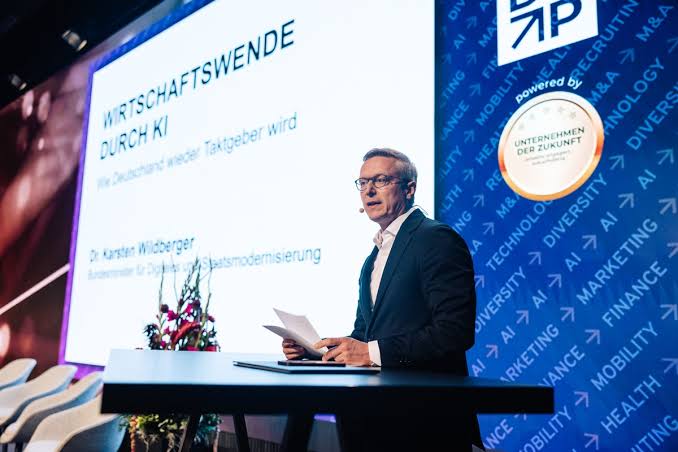
His framing of industry and AI
Documented statementIn a Handelsblatt interview on 18 November 2025, the headline quoted him: “Whoever misses the AI train risks leaving the market” (translated). In a web.de interview in April 2026 he said of AI: “This will decide prosperity in the 21st century” (translated headline quote).
AnalysisThe common thread in these statements is that digital infrastructure and AI adoption are treated as a question of economic competitiveness rather than only of technology or regulation. Critics from the opposition have argued that this framing neglects regulatory issues — see Criticism & Controversies.
- Destatis, GDP 2024 press release: destatis.de
- BMDS, Industrial AI Cloud: bmds.bund.de
- BMDS, data centre strategy speech: bmds.bund.de
- BMDS interim review, 7 Oct 2026: bmds.bund.de
- BMDS interviews and guest articles: bmds.bund.de