Deutschland-Stack
A sovereign, interoperable and EU-compatible IT platform for federal, state and municipal government. Participation process and consultation launched 9 October 2025.
Germany's first digital ministry combines two agendas: making public services digital, and reducing Europe's dependence on technologies controlled elsewhere.
Dates refer to cabinet decisions or official launches.
A sovereign, interoperable and EU-compatible IT platform for federal, state and municipal government. Participation process and consultation launched 9 October 2025.
Germany's version of the EU digital identity wallet: voluntary, free, launching 2 January 2027, with around 40 launch partners. Digital Identities Act adopted by cabinet in May 2026.
Citizens should submit data to authorities only once. Cabinet laid the basis in May 2025; the federal–state NOOTS treaty provides the technical framework.
Digital change of address (available to 55 million citizens by November 2025), digital vehicle registration documents and a combined digital application for founding a business (August 2026).
Data Act implementation law adopted by cabinet in October 2025; a new strategic framework for open data in July 2026; work on connecting data spaces.
Federal AI marketplace “MaKI” (January 2026), AI pilots in municipalities and a contract for a sovereign AI cloud (May 2026).
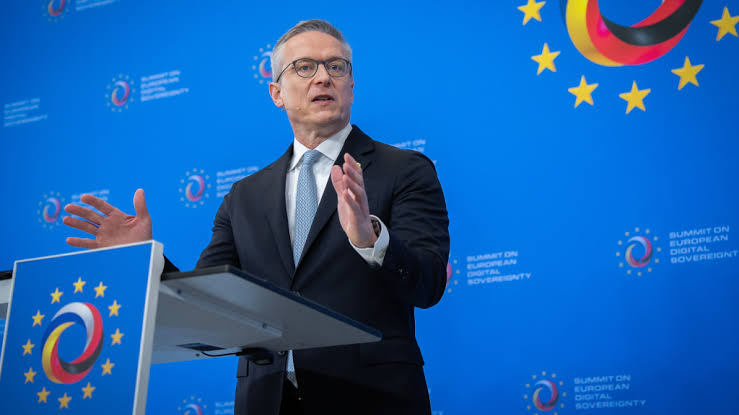
Co-chaired by Chancellor Merz and President Macron, with Wildberger giving the opening speech in English.
The summit at the EUREF-Campus in Berlin produced a Franco-German taskforce on digital sovereignty and commitments in seven areas, including simplification of EU digital rules — with a call to postpone the AI Act's high-risk provisions by 12 months — fair cloud markets, data sovereignty, digital public infrastructure and frontier AI. France, Germany, Mistral AI and SAP announced a sovereign AI for public administration.
Political position“Today, Germany, France and our European partners are making one thing unmistakably clear: we will shape Europe's digital future — together.”
He defines sovereignty as partnership rather than isolation: “Digital sovereignty doesn't mean isolation. It means trust in strong partnerships — and the ability to shape things ourselves” (4 November 2025, translated).
“Our digital identity belongs to the people — not the state, not the platforms, not the companies.”
Analysis“Opening an account, identifying yourself to an authority: in future this will be done securely with a smartphone, without paper copies, without an extra trip.”
The wallet is the most consumer-visible project of his term and will be a test of adoption: it is voluntary, and similar digital ID offers in Germany — such as the online function of the identity card — have historically seen limited use. The launch date of 2 January 2027 lies after the publication date of this archive.